

Staff Safety
Changing Consumer Attitudes on Sustainability
Manufacturers are improving operator safety through third-party services, such as continuous training from OEMs, risk assessments and new production line approaches from consultants. In addition, digital training at the machine level is increasing operator safety.
Modernization Investments Improve Operator Safety
By Grant Gerke
COVID-era adjustments, including more operator spacing on production lines, have remained due to increased line speeds. Photo courtesy of the Stellar Group
Operator safety remains a priority in the food industry. Capex investments in plant infrastructure and modern tools are increasing plant operator safety, and they're coming at the right time. Food brands consider the workforce to be a leading obstacle to growth. The 2024 Rockwell Automation State of Smart Manufacturing, CPG Edition, cited workforce retention, onboarding new employees, and attracting employees with desired skill sets as the top impediments to growth and productivity.
“Workers are inherently more attracted to environments they consider to be safe and resonate more — and stay longer — with potential employers that have adopted a stronger safety culture,” said Todd Gilliam, industry leader, hybrid industries, Rockwell Automation, in a recent FOOD ENGINEERING article.
Bottom line, food manufacturers are adopting tools, technology and platforms that increase operator safety. Investments include modern machine equipment with digital tools and services that enhance productivity and safety, new production line designs, new applications and outsourcing risk assessments.
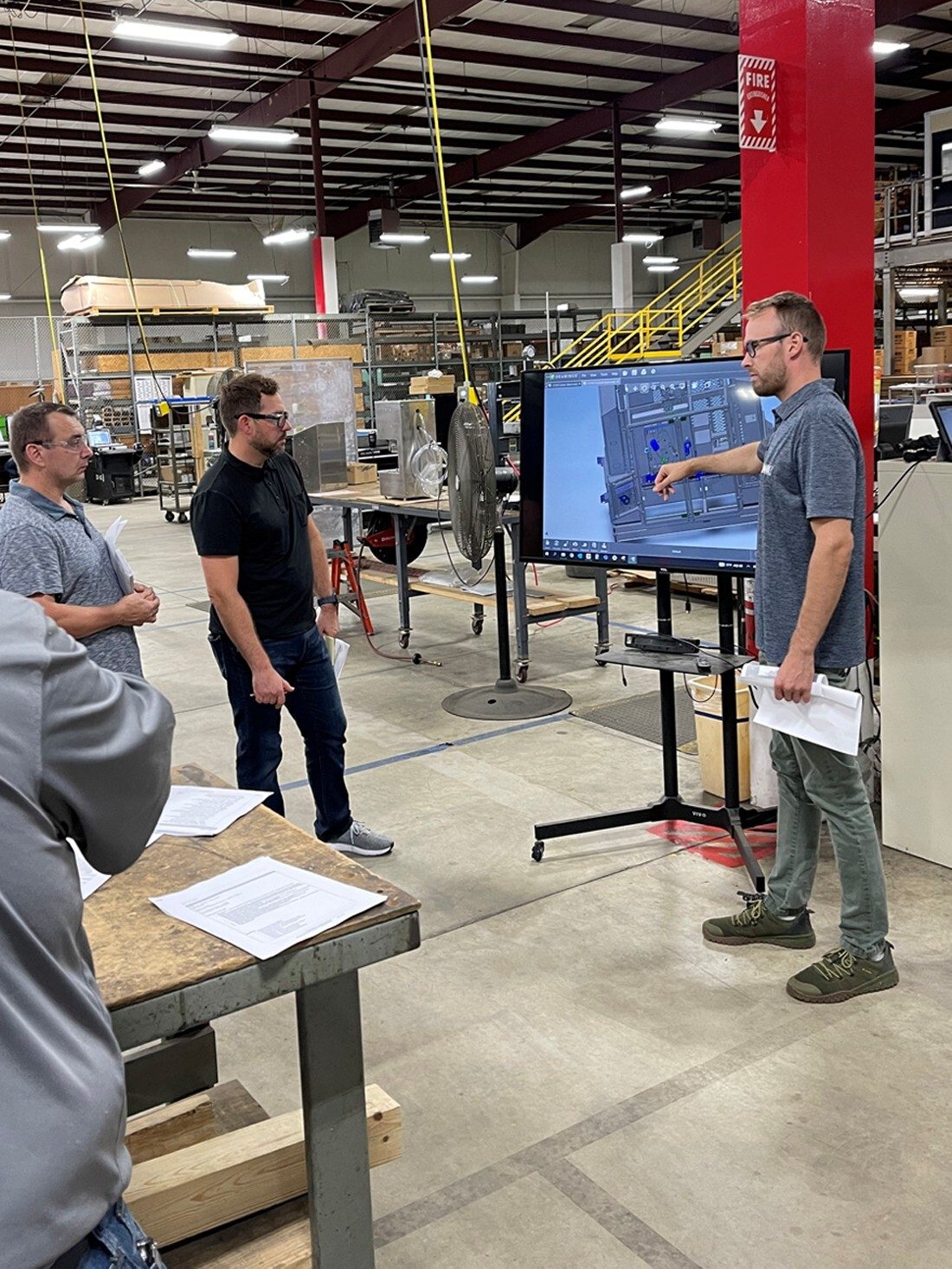
Machine builders provide a range of training options, such as troubleshooting and startup videos, on their websites and through in-person training at customer sites. Photo courtesy of Grote Company
The intersection of productivity and safety remains top of mind. “We’re continuously upgrading our equipment designs with safety in mind,” says Dan Friend, lifecycle leader at Grote Company. “Regardless of whether it’s regulated, it’s the right thing to do. Examples include guarding, fewer moving parts, tool-less changeouts and better clearance.”
Friend adds there is a greater emphasis on formal safety programs with clearer procedures such as lockout/tagout (LOTO), documented machine-specific steps and compliance with OSHA regulations.
“Processors tend to want more user and technical training support now due to labor shortages,” Friend says. “We’re helping processors add more automation, which reduces manual labor headcount. Grote Company provides a range of training options, such as troubleshooting and startup videos on its websites, as well as in-person training at customer sites or at their own facilities.
QAD Redzone’s Connected Workforce Solution provides a learning module, along with its productivity, compliance and reliability parts. The learning module offers training tutorials, video work instructions (or standard operating procedures) and tools to accelerate onboarding and upskill staff via an iPad work tablet or plant floor displays.
A December 2025 White Paper from PMMI Media on operator behavior and knowledge transfer reveals that CPG respondents believe there should be a central repository for training materials and captured knowledge.
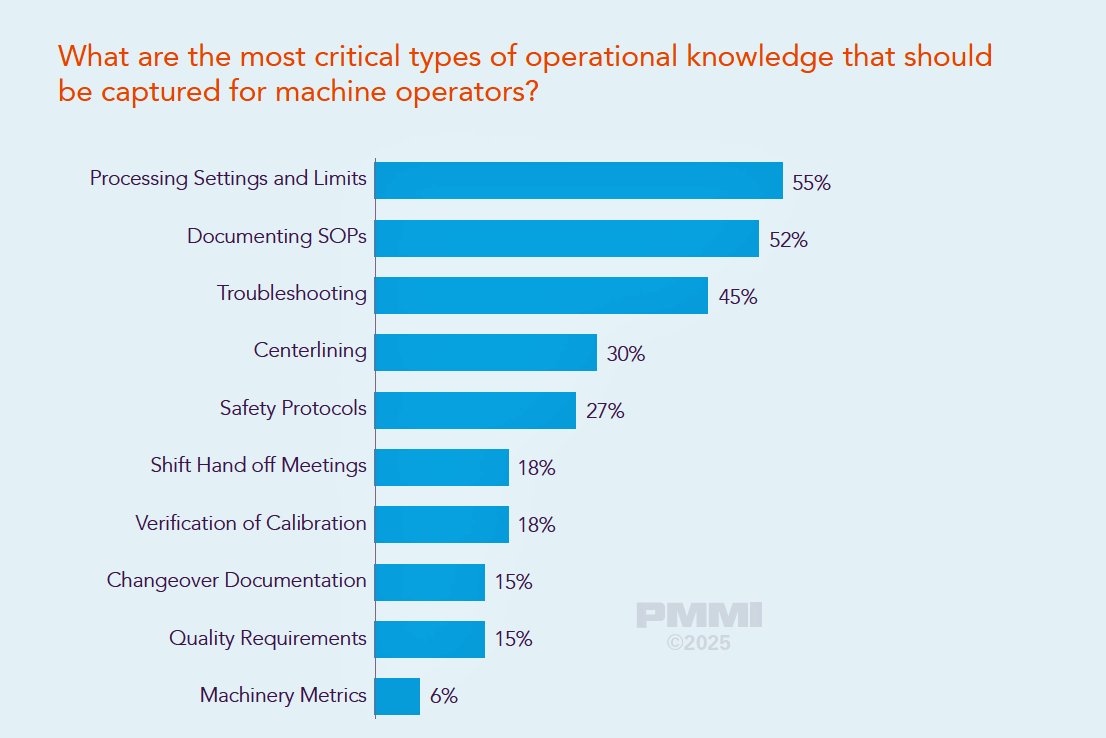
More data is being captured for operators, and food producers are using software solutions that allow personnel to see any safety-related protocols or SOPs on the plant floor. Graphic courtesy of PMMI Media
Operators, in general, are being overwhelmed with data on the plant floor, so simplifying screens, HMIs and tablets continues. “Modern HMI/SCADA designs emphasize high-performance graphics (per ISA-101 principles), which minimize nonessential color and visual clutter,” says Pradeep Paul, director of engineering, E Tech Group. “Screens are predominantly grayscale, so that only abnormal conditions use color, drawing the operator’s eye immediately to what matters. This improves situation awareness and speeds response without overwhelming new operators.”
Modern HMI Best Practices:
- High-performance HMI graphics (ISA-101): Grayscale base, limited color strictly for abnormal conditions
- Priority-based color conventions: Consistent visual hierarchy across units/lines
- Alarm escalation and notifications: Workflows that route high-priority events to SMEs and supervisors (email/SMS/paging) when acknowledgment or resolution stalls
- Situation-awareness displays: Overview-to-detail navigation that keeps the operator oriented during upsets
(Source: E Tech Group)
De-Risking via Automation and Risk Assessments
Contract food packagers and large food manufacturers are classic examples of adding automation to reduce operator risk and meet higher-volume goals. In 2022, Tyson Foods announced its plans “to invest over $1.3 billion in capital for new automation capabilities over the next three years to increase yields, reduce labor costs and associated risks, and ultimately deliver cumulative savings.” Contract packagers such as Cascade Coffee recently invested heavily in cobot applications for its end-of-line case packaging and palletizing.
“Repeated twisting and lifting overhead with manual palletizing is a demanding and rough ergonomic application,” says Michael DeGrace, key account manager at Teradyne Robotics. “It’s high priority for food producers to find ways to deploy automation and reduce risk whenever possible.”
Universal Robots, a division within Teradyne Robotics, offers a range of applications that focus on safety, productivity and throughput across manufacturing. “The platform is extremely flexible and our robots are deployed into a number of different applications requiring different safety considerations,” DeGrace adds. “The benefit of our platform, when it comes to safety in these applications, is the openness and accessibility of the software architecture. Partners are able to write their own APIs and give operators a way to control their devices all while not requiring a background in programming.”
Over the last year, there have been major achievements in industrial robotics regarding safety standards.
In early 2025, the International Organization for Standardization (ISO) released the revised ISO 10218 safety standard, which had not been updated since 2011. The two standards are ISO 10218-1: 2025 and ISO 10218-2:2025: 10218-1, which entail safety requirements for industrial robots (manufacturers), while 10218-2 covers industrial robot applications and robot cells (system integrators).
“These updates bring much-needed clarity and structure, making it easier for companies to integrate robotics with confidence,” says Roberta Nelson Shea, global technical compliance officer at Teradyne Robotics and convenor of ISO TC 299 Working Group 3.
DeGrace adds Universal Robots works with partners to provide customers with a range of services, including risk assessments and system integrations when in-house engineering resources are not an option. One example is SICK partnering with Universal Robots to develop an end-of-arm safeguard. In addition, SICK also offers risk consultation, full risk assessments and general guidance with Universal Robots.
Production Line Design Increases Operator Safety
The need for increased throughput in legacy and greenfield facilities is producing faster line speeds and new configurations. Derek Bickerton, senior vice president, food and beverage, at the Stellar Group points to line speeds and how production line designs have changed.
“As speeds rise, facilities often lengthen lines or split them into multiple parallel stations so operators have adequate space and time to work safely — particularly in areas like evisceration or knife-based tasks,” Bickerton says. The Stellar Group offers fully integrated design-build services including architecture, construction, engineering and more.
More automation is driving faster processing line speeds, and operator safety needs to be addressed. “As throughput increases — especially in protein processing — plants need more people on the line, which means extending workflows and spacing operators out to maintain safe working conditions,” Bickerton says.
Food processors have retained design ideas adopted during the COVID era, including physical barriers and additional spacing between workers. “U.S. plants generally provide more operator space, which translates to better comfort and reduced risk,” Bickerton says. “That said, most of these shifts have been driven more by production demands than by formal safety initiatives — but the result still benefits operators.”
As new challenges in production arise, food producers are increasingly turning to third-party architectural and consulting firms to implement sound workflow concepts. “More customers are now asking us to design the entire line from start to finish. Ten years ago, it was far more common for owners to select equipment independently and tap partners only for integration,” Bickerton says. “Now more projects involve full line design, from layout to equipment recommendations to system connection.”
The Stellar Group believes conversations about operator safety should include the practical realities driving change: production demands, spatial constraints and how processors balance the need for speed with the responsibility to keep their workforce safe. FE
next article