

Sustainability
Consumer preferences for recycled packaging are not unanimous, but they remain interested in sustainability practices. Meanwhile, food processors are strategically advancing energy efficiency programs that leverage advanced analytics and automation technologies.
Food Processors Tackle Sustainability
Through Packaging, Efficiency Initiatives But Challenges Remain
By Grant Gerke
Photo courtesy of Satriady Utomo / Getty Images
Boomers and Gen X consumers have soured on sustainability, according to recent research from Hartman.
The firm’s report, “Sustainability 2025: Do Consumers Care?,” reveals older consumers are less likely to consider environmental and social issues when purchasing food and beverages. However, Millennials — ages 29 to 44 — always or usually consider both environmental and social issues when making food and beverage purchases.
So, what’s the takeaway?
For now, sustainability remains important to younger consumers, and the report stresses food producers need to “go deeper” in sustainability applications for these customers.
Sustainability has been a consumer preference in food for more than 10 years, so it’s no surprise companies are continuing their efforts to find opportunities. In 2026, food producers are evaluating food waste opportunities, seeking sustainable packaging and some companies are employing energy efficiency design from the start.
Recycled PET Packaging Market in Trouble
In 2024, many food producers dropped their sustainable packaging requirements and officially postponed their commitments in 2025. The vision in the early 2020s was for material recycling facilities (MRFs), waste companies, associations, regulators and recyclers to create enough recycled polyethylene terephthalate (rPET) supply to meet sustainable packaging commitments made by Pepsi, Kraft Heinz, Coca-Cola and others.
But the supply of rPET never scaled to meet demand in 2023 and 2024, and post-consumer content (PCR) was competing against low-cost, virgin plastic resin, which did not have any “color” like recycled packaging.
Now, PET reclaimers are closing facilities in North America due to a lack of demand, and existing curbside recycling programs and MRFs are concerned. Overall capacity for PET reclaimers to take recycled material is down 40% in 2026.
“The story we have today is that there is less capacity domestically to turn curbside recycled PET into new packaging,” says Adam Gendell, director of material systems at The Recycling Partnership (TRP). “That's the problem that we need to solve.” Gendell stated this stark challenge during the March webinar, “How Industry Can Stabilize PET Recycling.”
Gendell cited closures of PET reclaiming facilities in California, which coincide with the state’s Extended Producer Responsibility (EPR) program that starts on Jan. 1, 2027.
“The most important step is to sell those recycled plastics to manufacturers to make new products, but the system is falling apart,” Gendell says. “Frankly, we're seeing the worst PET markets in 25 years, and you have Waste Management and Republic coming together with The Recycling Partnership, the two biggest recyclers in the country, saying there is a serious problem.”
The problem is that food and beverage producers are opting for virgin plastic at historically low prices. “Demand is low overall,” says Kate Bailey, chief policy officer at the Association for Plastic Recyclers (APR). “Today, there is more virgin PET plastic being produced in the history of the world and at unusually low prices. Earlier this month, the price of virgin PET was the same as in 2019. What else in your life is the same price as it was in 2019?”
While PET recycling collection is struggling, Mexico’s Arca Continental recently announced investment plans for its beverage plants and highlighted a $150 million investment in PetStar, the world’s largest food-grade PET recycling plant. According to Resource Recycling, Arca Continental increased its bottle collection network from 8 to 24 centers in 2025, and the company will aspire to 50% average recycled content by 2030, compared to its 2019 baseline of 24.7%.
Foundational Sustainable Design
Nature Fresh Farms, based in Ontario, Canada, is a greenhouse grower using a systems-based approach to sustainable food production. The company grows produce throughout the year and uses an integrated greenhouse production system to support efficient irrigation and resource use.
Nature Fresh Farms uses Priva, a greenhouse control platform, to oversee the growing of produce and manage over 250 acres — 160 in Canada and 90 in Ohio. In addition, the company’s tech stack includes autonomous growing tools, Blue Radix and Litmus for data and monitoring systems. These tools help run a closed-loop irrigation and fertigation system, water capture and reuse infrastructure, environmental and irrigation monitoring systems, and automated greenhouse control systems integrated with energy management platforms.
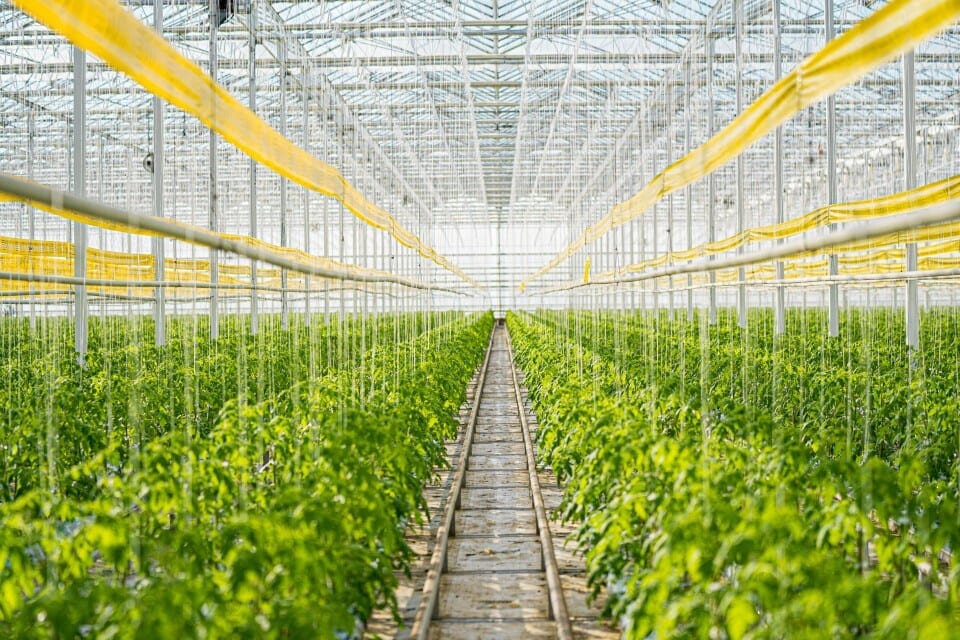
The recycled water initiative at Nature Fresh Farms began as a continuous improvement project focused on reducing irrigation loss and reusing captured runoff. Nature Fresh Farms
From the beginning, the foundation for Nature Fresh Farms has been the promise of technology to achieve sustainability. “Technology is at the center and allows us to realize what we could attain, could do and understand out there,” says Keith Bradley, VP of IT at Nature Fresh Farms.
The recycled water initiative began as a continuous improvement project focused on reducing irrigation loss and reusing captured runoff. “We reuse the recycled water over and over until it's just not usable again,” Bradley says. The recycled water system applies water to the plants, and any excess water flows to the return system, where it is cleaned.
Report - U.S. Food Waste Commitments in 2026
Consumers demand sustainability from food manufacturers. A December 2025 Hartman Group Sustainability report reveals that 72% of consumers would like companies' sustainable practices to be more visible.
ReFED, a U.S-based nonprofit working to solve food waste, recently released its U.S. Food Waste Commitment Landscape report. Food waste generates approximately 8%-10% percent of global greenhouse gas emissions, and ReFED employs data monitoring solutions to industries, businesses and more.
The new commitment report suggests a gap between acknowledgment and commitment to reducing food waste in a range of sectors. Across the retail, foodservice, manufacturing and Quick Service Restaurants (QSR), 55 of 75 companies (73%) reference food waste as a distinct issue in their public reporting. However, measurable targets are far less common.
The report shows 86% of manufacturers without a measurable target had donation programs. “Of the manufacturers analyzed, the vast majority of those with donation programs linked them to fighting hunger and food insecurity, regardless of whether they had a measurable target,” says Jailyn Knott, business initiatives analyst at ReFED.
With commitments waning, FOOD ENGINEERING asked ReFED about trends in manufacturers' operations going forward. ReFED said there are no quantitative indicators of where manufacturing commitments are moving.
“However, during our research, we identified a few manufacturing sector-specific factors that could influence the adoption of measurable targets,” Knott adds. “First, the manufacturers that we analyzed often had global operations, meaning they may be subject to food waste reduction standards outside of the U.S.”
ReFED’s Food Waste Monitor also shows that 90% of surplus food generated in the manufacturing sector comes from byproducts and production line waste. According to the non-profit, future research will monitor whether these production-line inefficiencies influence the commitment landscape.
“If we send 20 milliliters of water to the plant and it only absorbs 15 of it, the other five of it will drip to the bottom and we'll recapture and reclean it up,” Bradley says. The company also captures CO₂ from natural gas combustion and reuses it for greenhouse enrichment, supporting plant growth and improving production efficiency.
Many food manufacturers have turned to energy-efficient initiatives, but Nature Fresh Farms uses this technology stack to scale these efficiencies across its greenhouses. “A key point that often gets overlooked is that sustainability at Nature Fresh Farms is fully integrated into its production model rather than operating as a standalone initiative,” Bradley says. FE
next article